
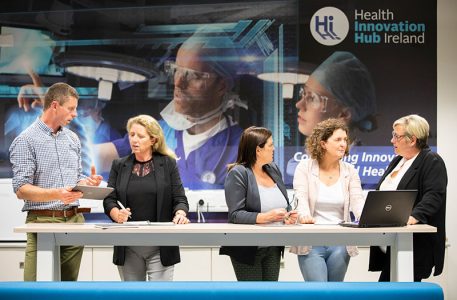







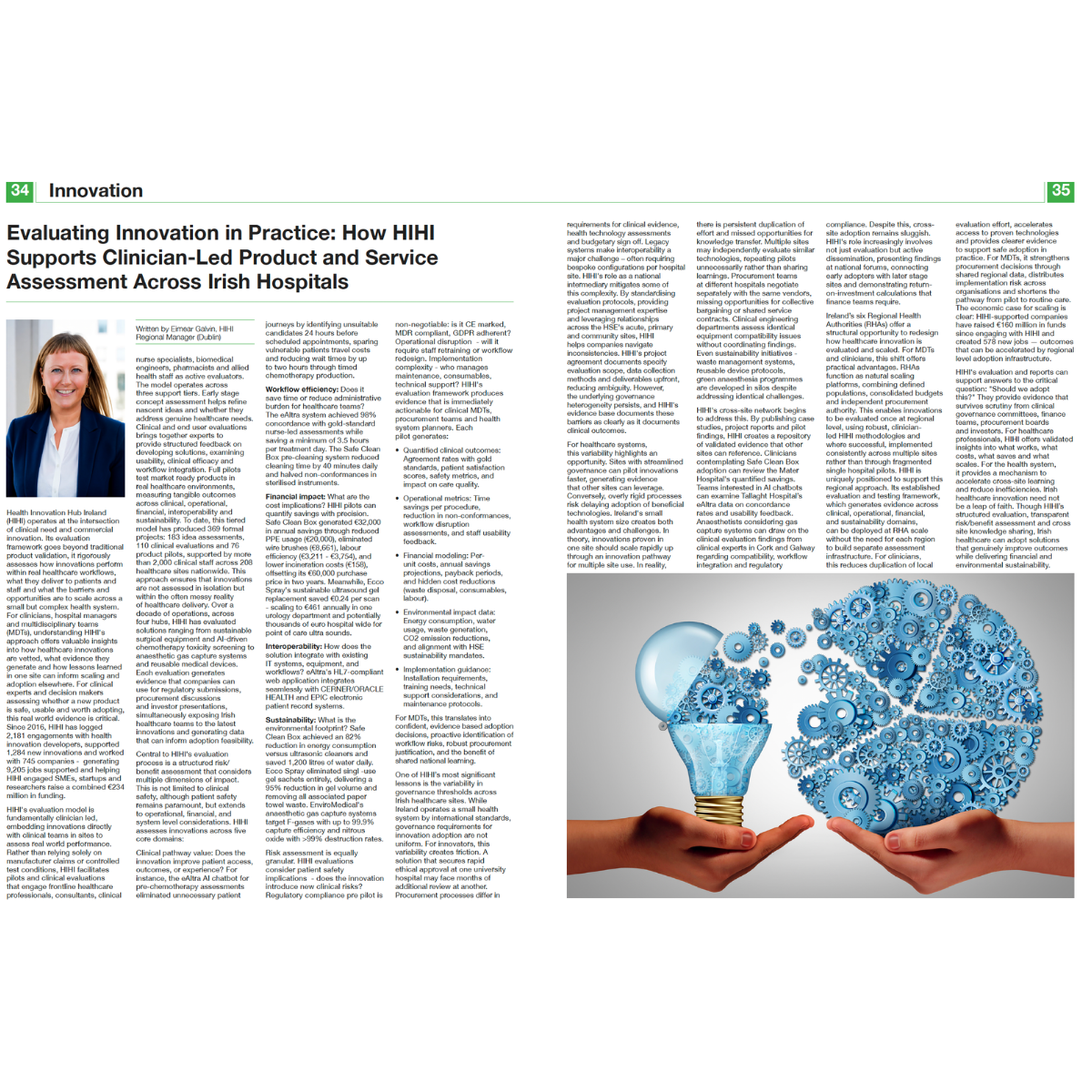
In this month’s Hospital Professional News, our Dublin Manager, Eimear Galvin writes about HIHI supporting clinician led product and service assessment across Irish hospitals
Evaluating Innovation in Practice: How HIHI Supports Clinician-Led Product and Service Assessment Across Irish Hospitals
Health Innovation Hub Ireland (HIHI) operates at the intersection of clinical need and commercial innovation. Its evaluation framework goes beyond traditional product validation, it rigorously assesses how innovations perform within real healthcare workflows, what they deliver to patients and staff and what the barriers and opportunities are to scale across a small but complex health system. For clinicians, hospital managers and multidisciplinary teams (MDTs), understanding HIHI’s approach offers valuable insights into how healthcare innovations are vetted, what evidence they generate and how lessons learned in one site can inform scaling and adoption elsewhere. For clinical experts and decision makers assessing whether a new product is safe, usable and worth adopting, this real world evidence is critical. Since 2016, HIHI has logged 2,181 engagements with health innovation developers, supported 1,284 new innovations and worked with 745 companies – generating 9,205 jobs supported and helping HIHI engaged SMEs, startups and researchers raise a combined €234 million in funding.
HIHI’s evaluation model is fundamentally clinician led, embedding innovations directly with clinical teams in sites to assess real world performance. Rather than relying solely on manufacturer claims or controlled test conditions, HIHI facilitates pilots and clinical evaluations that engage frontline healthcare professionals, consultants, clinical nurse specialists, biomedical engineers, pharmacists and allied health staff as active evaluators. The model operates across three support tiers. Early stage concept assessment helps refine nascent ideas and whether they address genuine healthcare needs. Clinical and end user evaluations brings together experts to provide structured feedback on developing solutions, examining usability, clinical efficacy and workflow integration. Full pilots test market ready products in real healthcare environments, measuring tangible outcomes across clinical, operational, financial, interoperability and sustainability. To date, this tiered model has produced 369 formal projects: 183 idea assessments, 110 clinical evaluations and 76 product pilots, supported by more than 2,000 clinical staff across 208 healthcare sites nationwide. This approach ensures that innovations are not assessed in isolation but within the often messy reality of healthcare delivery. Over a decade of operations, across four hubs, HIHI has evaluated solutions ranging from sustainable surgical equipment and AI-driven chemotherapy toxicity screening to anaesthetic gas capture systems and reusable medical devices. Each evaluation generates evidence that companies can use for regulatory submissions, procurement discussions and investor presentations, simultaneously exposing Irish healthcare teams to the latest innovations and generating data that can inform adoption feasibility.
Central to HIHI’s evaluation process is a structured risk/benefit assessment that considers multiple dimensions of impact. This is not limited to clinical safety, although patient safety remains paramount, but extends to operational, financial, and system level considerations. HIHI assesses innovations across five core domains:
Clinical pathway value: Does the innovation improve patient access, outcomes, or experience? For instance, the eAltra AI chatbot for pre-chemotherapy assessments eliminated unnecessary patient journeys by identifying unsuitable candidates 24 hours before scheduled appointments, sparing vulnerable patients travel costs and reducing wait times by up to two hours through timed chemotherapy production.
Workflow efficiency: Does it save time or reduce administrative burden for healthcare teams? The eAltra system achieved 98% concordance with gold-standard nurse-led assessments while saving a minimum of 3.5 hours per treatment day. The Safe Clean Box pre-cleaning system reduced cleaning time by 40 minutes daily and halved non-conformances in sterilised instruments.
Financial impact: What are the cost implications? HIHI pilots can quantify savings with precision. Safe Clean Box generated €32,000 in annual savings through reduced PPE usage (€20,000), eliminated wire brushes (€8,661), labour efficiency (€3,211 – €3,754), and lower incineration costs (€158), offsetting its €60,000 purchase price in two years. Meanwhile, Ecco Spray’s sustainable ultrasound gel replacement saved €0.24 per scan – scaling to €461 annually in one urology department and potentially thousands of euro hospital wide for point of care ultra sounds.
Interoperability: How does the solution integrate with existing IT systems, equipment, and workflows? eAltra’s HL7-compliant web application integrates seamlessly with CERNER/ORACLE HEALTH and EPIC electronic patient record systems.
Sustainability: What is the environmental footprint? Safe Clean Box achieved an 82% reduction in energy consumption versus ultrasonic cleaners and saved 1,200 litres of water daily. Ecco Spray eliminated singl -use gel sachets entirely, delivering a 95% reduction in gel volume and removing all associated paper towel waste. EnviroMedical’s anaesthetic gas capture systems target F-gases with up to 99.9% capture efficiency and nitrous oxide with >99% destruction rates.
Risk assessment is equally granular. HIHI evaluations consider patient safety implications – does the innovation introduce new clinical risks? Regulatory compliance pre pilot is non-negotiable: is it CE marked, MDR compliant, GDPR adherent? Operational disruption – will it require staff retraining or workflow redesign. Implementation complexity – who manages maintenance, consumables, technical support? HIHI’s evaluation framework produces evidence that is immediately actionable for clinical MDTs, procurement teams and health system planners. Each pilot generates:
- Quantified clinical outcomes: Agreement rates with gold standards, patient satisfaction scores, safety metrics, and impact on care quality.
- Operational metrics: Time savings per procedure, reduction in non-conformances, workflow disruption assessments, and staff usability feedback.
- Financial modeling: Per-unit costs, annual savings projections, payback periods, and hidden cost reductions (waste disposal, consumables, labour).
- Environmental impact data: Energy consumption, water usage, waste generation, CO2 emission reductions, and alignment with HSE sustainability mandates.
- Implementation guidance: Installation requirements, training needs, technical support considerations, and maintenance protocols.
For MDTs, this translates into confident, evidence based adoption decisions, proactive identification of workflow risks, robust procurement justification, and the benefit of shared national learning.
One of HIHI’s most significant lessons is the variability in governance thresholds across Irish healthcare sites. While Ireland operates a small health system by international standards, governance requirements for innovation adoption are not uniform. For innovators, this variability creates friction. A solution that secures rapid ethical approval at one university hospital may face months of additional review at another. Procurement processes differ in requirements for clinical evidence, health technology assessments and budgetary sign off. Legacy systems make interoperability a major challenge – often requiring bespoke configurations per hospital site. HIHI’s role as a national intermediary mitigates some of this complexity. By standardising evaluation protocols, providing project management expertise and leveraging relationships across the HSE’s acute, primary and community sites, HIHI helps companies navigate inconsistencies. HIHI’s project agreement documents specify evaluation scope, data collection methods and deliverables upfront, reducing ambiguity. However, the underlying governance heterogeneity persists, and HIHI’s evidence base documents these barriers as clearly as it documents clinical outcomes.
For healthcare systems, this variability highlights an opportunity. Sites with streamlined governance can pilot innovations faster, generating evidence that other sites can leverage. Conversely, overly rigid processes risk delaying adoption of beneficial technologies. Ireland’s small health system size creates both advantages and challenges. In theory, innovations proven in one site should scale rapidly up through an innovation pathway for multiple site use. In reality, there is persistent duplication of effort and missed opportunities for knowledge transfer. Multiple sites may independently evaluate similar technologies, repeating pilots unnecessarily rather than sharing learnings. Procurement teams at different hospitals negotiate separately with the same vendors, missing opportunities for collective bargaining or shared service contracts. Clinical engineering departments assess identical equipment compatibility issues without coordinating findings. Even sustainability initiatives – waste management systems, reusable device protocols, green anaesthesia programmes are developed in silos despite addressing identical challenges.
HIHI’s cross-site network begins to address this. By publishing case studies, project reports and pilot findings, HIHI creates a repository of validated evidence that other sites can reference. Clinicians contemplating Safe Clean Box adoption can review the Mater Hospital’s quantified savings. Teams interested in AI chatbots can examine Tallaght Hospital’s eAltra data on concordance rates and usability feedback. Anaesthetists considering gas capture systems can draw on the clinical evaluation findings from clinical experts in Cork and Galway regarding compatibility, workflow integration and regulatory compliance. Despite this, cross-site adoption remains sluggish. HIHI’s role increasingly involves not just evaluation but active dissemination, presenting findings at national forums, connecting early adopters with later stage sites and demonstrating return-on-investment calculations that finance teams require.
Ireland’s six Regional Health Authorities (RHAs) offer a structural opportunity to redesign how healthcare innovation is evaluated and scaled. For MDTs and clinicians, this shift offers practical advantages. RHAs function as natural scaling platforms, combining defined populations, consolidated budgets and independent procurement authority. This enables innovations to be evaluated once at regional level, using robust, clinician-led HIHI methodologies and where successful, implemented consistently across multiple sites rather than through fragmented single hospital pilots. HIHI is uniquely positioned to support this regional approach. Its established evaluation and testing framework, which generates evidence across clinical, operational, financial, and sustainability domains, can be deployed at RHA scale without the need for each region to build separate assessment infrastructure. For clinicians, this reduces duplication of local evaluation effort, accelerates access to proven technologies and provides clearer evidence to support safe adoption in practice. For MDTs, it strengthens procurement decisions through shared regional data, distributes implementation risk across organisations and shortens the pathway from pilot to routine care. The economic case for scaling is clear: HIHI-supported companies have raised €160 million in funds since engaging with HIHI and created 578 new jobs — outcomes that can be accelerated by regional level adoption infrastructure.
HIHI’s evaluation and reports can support answers to the critical question: “Should we adopt this?” They provide evidence that survives scrutiny from clinical governance committees, finance teams, procurement boards and investors. For healthcare professionals, HIHI offers validated insights into what works, what costs, what saves and what scales. For the health system, it provides a mechanism to accelerate cross-site learning and reduce inefficiencies. Irish healthcare innovation need not be a leap of faith. Though HIHI’s structured evaluation, transparent risk/benefit assessment and cross site knowledge sharing, Irish healthcare can adopt solutions that genuinely improve outcomes while delivering financial and environmental sustainability.