







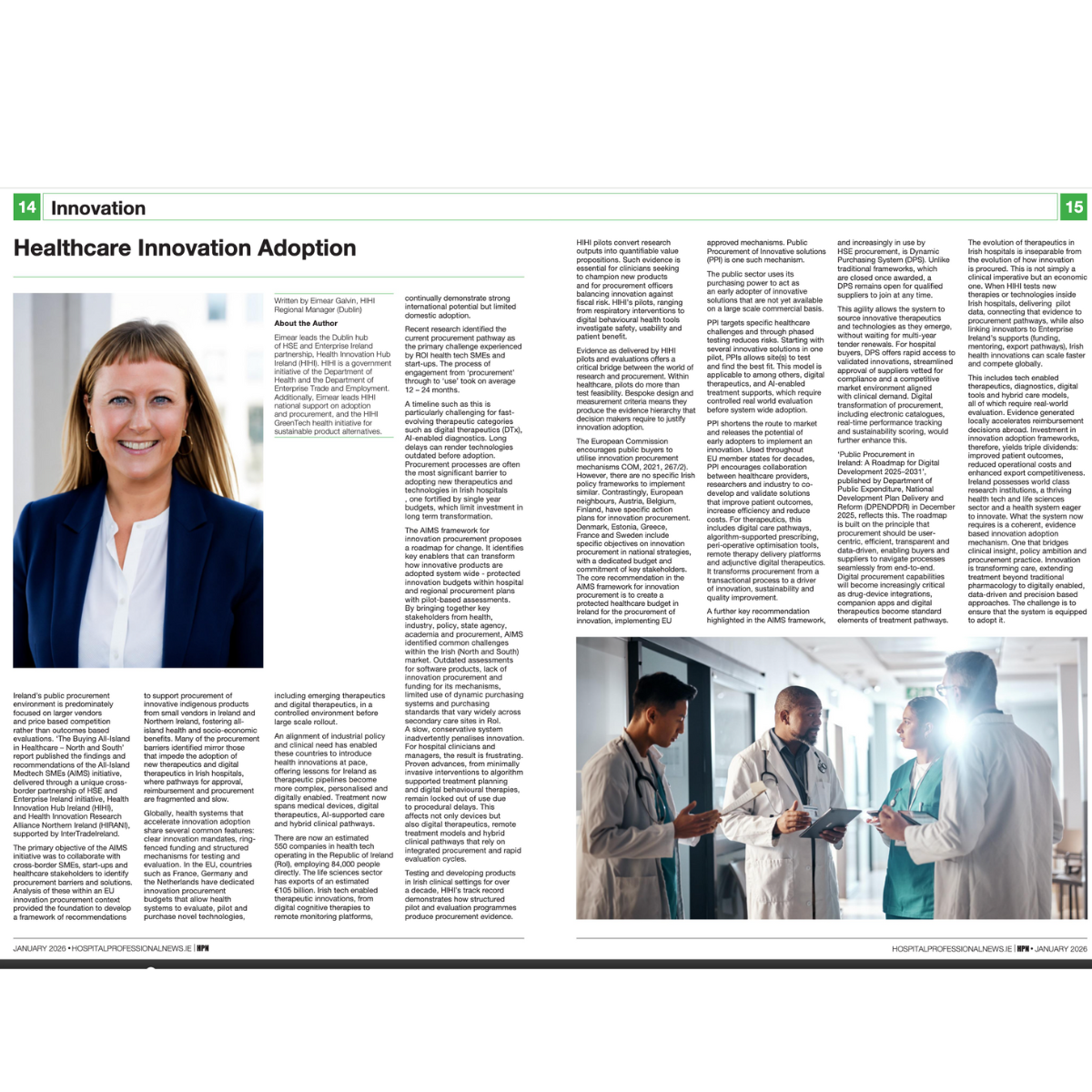
HIHI Dublin Manager, Eimear Galvin writes in Hospital Professional News on healthcare innovation and adoption in Ireland
Globally, health systems that accelerate therapeutic adoption share several common features: clear innovation mandates, ring-fenced funding and structured mechanisms for testing and evaluation. In the EU, countries such as France, Germany and the Netherlands, dedicated innovation procurement budgets allow health systems to evaluate, pilot and purchase novel technologies in a controlled environment before large scale roll out. By contrast, Ireland’s public procurement environment remains focussed on larger vendors and price based competition rather than outcomes based evaluations. The ‘Buying All-island in Healthcare – North and South’ report published the findings and recommendations of the All-Island Medtech SMEs (AIMS) initiative, delivered through a unique cross border partnership of HSE and Enterprise Ireland initiative Health Innovation Hub Ireland (HIHI) and Health Innovation Research Alliance Northern Ireland (HIRANI), supported by InterTradeIreland, over eight months in 2023. The primary objective of the AIMS initiative was to collaborate with cross-border SMEs, start-ups and healthcare stakeholders to identify procurement barriers and solutions. Analysis of these within an EU innovation procurement context provided the foundation to develop a framework of recommendations to support procurement of innovative indigenous products from small vendors in Ireland and Northern Ireland, fostering all island health and socio-economic benefits.
There are now an estimated 550 companies in health tech operating in the Republic of Ireland (RoI), employing 84,000 people directly. The life sciences sector has exports of an estimated €105 billion. The benefit to the Irish health system of Irish suppliers was proven during Covid when Irish companies addressed many elements of healthcare problems from the provision of PPE to the use of innovative tech solutions in patient care. Ireland is one of the most successful European exporters in health tech and life sciences, yet indigenous companies struggle to achieve procurement here. Recent research identified the current procurement pathway as the primary challenge experienced by ROI health tech SMEs and start-ups. The process of engagement from ‘procurement’ through to ‘use’ took on average 12-24 months. Procurement processes are often the most significant barrier to adopting new therapeutics and technologies in Irish hospitals. The AIMS framework for innovation procurement proposes a roadmap for change. It identifies key enablers that can transform how therapeutics move from idea to adoption: protected innovation budgets within hospital and regional procurement plans with pilot-based validation, producing real-world clinical and economic evidence. These enablers are not merely theoretical. Testing and developing products in Irish clinical settings for over a decade, HIHI’s track record demonstrates how structured pilot and evaluation programmes produce procurement ready evidence. HIHI pilots convert research outputs into quantifiable value propositions. Such evidence is essential for clinicians seeking to champion new product adoption and for procurement officers balancing innovation against fiscal and regulatory risk.
By bringing together key stakeholders from health, industry, policy, state agency, academia and procurement, common challenges within the Irish (North and South) market were identified. New and smaller suppliers below certain revenue thresholds are not equally positioned to compete with established vendors for healthcare tenders, unfairly affected by scale and liquidity requirements. Outdated assessments for software products, lack of innovation procurement and funding for its mechanisms, limited use of dynamic purchasing systems and purchasing standards that vary widely across secondary care sites in RoI are also perceived to be prohibitive. A slow, conservative system inadvertently penalises innovation. For hospital clinicians and managers, the result is frustrating: proven therapeutic advances and digital solutions remain locked out of use due to procedural inertia. For innovators, the uncertainty and timescale of procurement stalls commercialisation and investment. Pilot evidence as delivered by HIHI pilots and evaluations, offer a critical bridge between the world of research and the machinery of procurement. Within healthcare, pilots do more than test feasibility – bespoke design and measurement criteria means they can generate the evidence hierarchy that decision makers require to justify adoption. HIHI’s model demonstrates the power of structured, multi-stakeholder pilots.
The European Commission encourages public buyers to utilise innovation procurement mechanisms to provide vital opportunities to SMEs and new innovative companies (COM, 2021, 267/2). However, there are no specific Irish policy frameworks on innovation procurement, driving public buyer engagement with smaller vendors. This is in stark contrast to common European practice. Austria, Belgium, Finland, have specific action plans for innovation procurement. Denmark, Estonia, Greece, France and Sweden include specific objectives on innovation procurement in national strategies, with a dedicated budget and commitment of key stakeholders. The core recommendation in the AIMS framework for innovation procurement is to create a protected healthcare budget for the procurement of innovation, implementing EU approved mechanisms. Public Procurement of Innovative solutions (PPI) is one such mechanism. The public sector uses its purchasing power to act as an early adopter of innovative solutions that are not yet available on a large scale commercial basis. PPI can target specific healthcare challenges by seeking innovative solutions and through a testing phase, reduce risks commonly associated with smaller vendors. Starting with several innovative solutions in one pilot, PPIs allows site(s) to test and find the best fit.
Using PPI, public authorities act as the early adopter of innovative goods or services. PPI shortens the route to market and releases the potential of early adopters to implement an innovation. Starting with several innovative solutions in one pilot, PPIs allows site(s) to test and find the best fit. Used successfully throughout EU member states for years, Dublin City Council adopted PPI in 2019 to test Low-cost Low-Power Wide Area Network (LPWAN – a new type of connectivity innovation) sensors to monitor ring buoys. Framework agreements were awarded to four suppliers allowing 23 local authorities to avail of the framework agreements as purchaser. Used throughout EU member states for decades, PPI is a strategic approach that enables healthcare systems to modernise by actively sourcing and adopting new products to address unmet clinical and operational needs. PPI encourages collaboration between healthcare providers, researchers and industry to codevelop and validate solutions that improve patient outcomes, increase efficiency, and reduce costs. It transforms procurement from a transactional process into a driver of innovation, sustainability and quality improvement. Healthcare systems deliver better, safer, and more sustainable care while fostering a thriving innovation ecosystem.
Another recommendation highlighted in the AIMS study and increasingly in use by HSE procurement is the Dynamic Purchasing System (DPS). Unlike traditional frameworks, which are closed once awarded, a DPS remains open for qualified suppliers to join at any time. This agility allows the system to source innovative therapeutics and technologies as they emerge, without waiting for multi-year tender renewals. For hospital buyers, DPS offers: rapid access to validated innovations, streamlined approval of suppliers vetted for compliance and a competitive, flexible market environment aligned with clinical demand. Digital transformation of procurement, including electronic catalogues, real-time performance tracking, and sustainability scoring, could further accelerate this process, existing in parallel with innovation, rather than constantly trying to catch up. Published by DEPER in December 2025, ‘Public Procurement in Ireland: A roadmap for digital development 2025 – 2031’ reflects this. The roadmap is built on the principle that procurement should be user centric, efficient, transparent, and data-driven, enabling buyers and suppliers to navigate processes seamlessly from end-to-end. It emphasises digital solutions that deliver better data, reduce administrative burden and support compliance with legal and EU policy frameworks.
The evolution of therapeutics in Irish hospitals is inseparable from the evolution of how innovation is adopted, validated and procured. This is not simply a clinical imperative but an economic one. By integrating hospital pilot data and procurement pathways with enterprise support mechanisms provided by Enterprise Ireland, Ireland can turn domestic innovation into international advantage. The same principle applies to therapeutics, evidence generated locally accelerates reimbursement decisions abroad. Investment in innovation adoption frameworks, therefore, yields triple dividends: improved patient outcomes, reduced operational costs and enhanced export competitiveness. The findings of Buying All-Island in Healthcare make one message clear: the barriers are structural. Ireland possesses world-class research institutions, a thriving health tech and life sciences sector and a health system eager to innovate. What it needs is a coherent, evidence-based adoption framework one that bridges clinical insight, policy ambition and procurement practice. Innovation in therapeutics is not a distant goal, it is already happening. The task now is to ensure that the system is ready, willing, and equipped to adopt it.